How to Position Your Expert Business as a Category of One in 2026
I spent 25 years building businesses before I understood what actually makes someone choose you.
It wasn't my credentials. It wasn't my portfolio. It wasn't even the quality of my work.
It was whether they could see themselves getting this result anywhere else.
When you compete on quality, you're asking buyers to compare. When you compete on singularity, comparison becomes irrelevant. You become the only logical choice for a specific transformation.
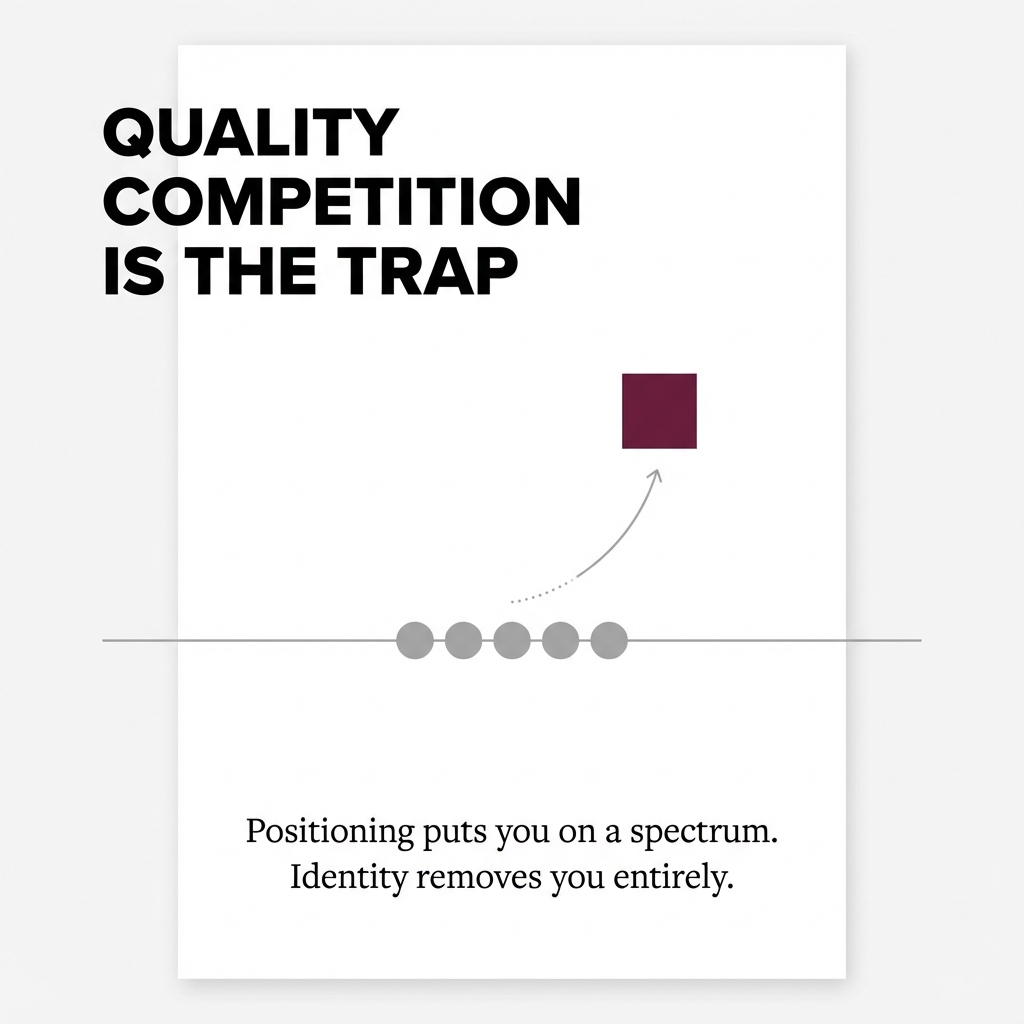
This is the difference between positioning and identity. Positioning puts you on a spectrum. Identity removes you from it entirely.
And it works whether you're serving luxury markets or any other expert-dependent field where decision-making involves discretion, consideration cycles, and outcome certainty.
Why Quality Competition Keeps You Trapped
Here's what happens when you compete on quality:
You attract comparison shoppers. You justify your pricing. You lose opportunities to cheaper alternatives who "seem good enough." You spend energy convincing people you're worth working with.
You're playing a game you can't win.
Because in expert services, quality is expected. It's the baseline. Every consultant claims deep expertise. Every agency promises bespoke service. Every coach talks about transformational results.
The moment you compete on quality, you've positioned yourself as interchangeable. You're asking buyers to assess degrees of excellence they can't actually measure until after they've worked with you.
Research on brand positioning confirms this principle: being unique is what counts, not any comparison with a competitor. Your work becomes the expression of a methodology, a creative identity that belongs to you alone.
Quality is comparative. Identity is absolute.
The Category of One Framework
Harvard Business School research found that 54% of fast-growing companies were category creators who presented a new worldview. More importantly, one company takes two-thirds of the economics in any category.
The category king doesn't compete. They define.
I saw this firsthand with a technology company that came to me after spending £5,000 on a lead generation agency. They received 70+ leads. They qualified three. They converted zero.
Why?
Because their message positioned them as a service provider competing on capability. Every prospect they spoke to was comparing quotes, looking for the best deal on the same outcome.
We shifted their message from capability-focused ("we deliver world-class installations") to transformation-focused ("we architect sensory experiences for discerning clients who value lasting family memories over technical specifications").
Same service. Different category.
Within 90 days, their average project value increased 75%. They stopped competing on price because they stopped being comparable.
The Preeminence Checklist: Becoming Categorically Unique
Positioning yourself as a category of one requires architectural precision. You're building identity, not marketing messages.
This works regardless of your market. Whether you serve luxury clients, mid-market businesses, or specialized niches, the framework remains the same: establish categorical distinction that makes comparison irrelevant.
Here's the framework I use with every client:
1. Define Your Singular Transformation
You don't sell services. You deliver a specific transformation that only exists through your methodology.
Apple doesn't sell computers. They sell the integration of technology and liberal arts. Salesforce doesn't sell software. They sell the transformation from traditional CRM to cloud-based business ecosystems.
Your transformation must be:
Specific enough that it excludes. If everyone qualifies, nobody converts.
Valuable enough that price becomes secondary. Serious buyers pay premiums for certainty, not features.
Defensible enough that it can't be copied. Your methodology, your philosophy, your unique combination of elements.
When a prospective client told me their vision for their business, I could have agreed and confirmed I could deliver it. Instead, I challenged their assumptions. I explained why their approach would limit their outcome and what I would do differently.
They paid substantially more than their initial budget because I offered transformation they couldn't access elsewhere.
2. Establish Your Intangible Singularity Elements
Strategic positioning research confirms that being expensive fails to differentiate. What creates pricing power is leveraging intangible elements of singularity—time invested mastering your craft, heritage of your methodology, craftsmanship in delivery, selectivity in client engagement, and demonstrated outcomes with discerning buyers.
You need to identify yours:
Time: How long have you refined this approach? What patterns have you observed across hundreds of projects that inform your methodology?
Heritage: What tradition or lineage does your work connect to? What principles guide your decisions?
Craftsmanship: What do you do by hand that others automate? What details do you obsess over that others overlook?
Selectivity: Who do you turn away? What projects don't align with your philosophy?
These elements can't be fabricated. They emerge from honest interrogation of what makes your approach irreplicable.
3. Create Strategic Scarcity
Rarity attracts. Availability repels.
Leading professional services firms deliberately limit client capacity, creating natural scarcity that reinforces desirability. The best consultants, designers, and specialists maintain waiting lists not through artificial urgency but through operational reality.
This isn't artificial urgency. It's operational reality aligned with positioning.
When you work with fewer clients at higher value, you're not limiting revenue. You're concentrating it. You're trading volume for margin, exhaustion for sustainability.
The expert businesses I work with don't need more leads. They need better message-market fit that attracts pre-qualified buyers who understand the value before the first conversation.
4. Build Your Proprietary Methodology
Research shows companies with proprietary methodologies command 25% higher fees than comparable service providers.
Your methodology is the codification of your unique approach. It's the system that delivers your transformation consistently.
It includes:
Your diagnostic framework: How you assess whether a project aligns with your philosophy
Your delivery process: The specific steps that ensure outcome certainty
Your quality standards: The non-negotiable elements that define your work
Your client experience: How interaction with you differs from interaction with alternatives
When I built my own system after hitting a £2.5m revenue ceiling, I realised the constraint wasn't capability. It was that my business required my continuous presence.
I codified my approach into a methodology that operated independently of my hourly input. That's what allowed scale without replication.
5. Communicate Through Transformation, Not Features
Expert service purchasing decisions involve extended consideration cycles. Buyers invest substantial time because significant investments—whether financial, strategic, or operational—demand meticulous thought.
Your messaging must pre-frame the transformation so thoroughly that by the time they engage, they're already convinced.
This means:
Leading with outcome, not process. They don't care about your tools. They care about the life they'll live after you've completed the work.
Demonstrating philosophy, not capability. Capability is assumed. Philosophy is what makes you singular.
Educating on distinction, not superiority. You're not better than alternatives. You're different in ways that matter to specific people.
When I worked with a branding agency early on, they created beautiful content. But it didn't generate revenue because it showcased our work without communicating our unique value.
We repurposed that content with new messaging that positioned our transformation. Same assets, different framing, measurable revenue impact.
The Pricing Signal: Why Higher Prices Enhance Perception
Robert Cialdini documented a jewellery store that accidentally doubled the price of turquoise pieces. They sold out immediately.
The inflated price made the jewellery irresistible to buyers who had previously ignored it. Higher price signalled higher value, even without explanation.
The Hollywood Bowl in Los Angeles sells concert tickets for a dollar. These seats offer better city views, prime sunset viewing, and identical acoustics to expensive seats below. They often sit empty because the low price signals inferior quality.
Underpricing signals inferiority. Premium pricing signals certainty.
Research on prestige pricing confirms that "high prices enhance a brand's perceived exclusivity, making them more desirable to consumers and encouraging purchase decisions."
When you price at premium levels, you're not deterring buyers. You're attracting the ones who understand value.
The technology company I mentioned earlier didn't just change their messaging. They increased their pricing to align with their new positioning. Their conversion rate improved because their pricing confirmed their categorical uniqueness.
The 2026 Expert Services Landscape: Clarity Over Complexity
Recent analysis of professional services strategy identifies what matters in 2026: clarity of positioning, defensible methodology, and systematic client acquisition that doesn't depend on founder availability.
The expert businesses that thrive will establish what they stand for—and what they will not compromise—whilst systematizing value delivery through proprietary frameworks, selective engagement, and message architecture that pre-qualifies demand.
This means:
Clarity of identity becomes non-negotiable. Ambiguity in positioning is the root pathology. Generic messaging fails to generate magnetism.
Selectivity becomes strategic advantage. Saying no to wrong-fit demand strengthens your position with right-fit buyers.
Systematised voice replaces personality dependence. Your business must operate independently of your continuous presence to achieve scale and saleability.
The expert businesses stuck below £1m annually aren't lacking capability. They're invisible outside their referral network because their message doesn't establish categorical distinction.
Building Your Category of One: The Implementation Path
Positioning yourself as categorically unique isn't a marketing exercise. It's foundational architecture.
Here's the sequence:
Foundation audit: Interrogate your unique value proposition. What transformation do you deliver that exists nowhere else? What combination of elements makes your approach irreplicable?
Competitive landscape analysis: Identify where competitors position themselves. Find the territory they've abandoned or never occupied. Claim it.
Message architecture: Build the linguistic infrastructure that communicates your singularity. This operates as pre-qualification, eliminating low-fit demand whilst magnetising ideal clients.
Proof deployment: Demonstrate your transformation through client outcomes, proprietary frameworks, and thought leadership that establishes authority.
Systematic iteration: Track conversion efficiency. Measure how many prospects arrive pre-sold versus requiring persuasion. Refine until conversion approaches inevitability.
This takes 90 days minimum. You're rebuilding how the market perceives you. You're extracting implicit positioning into explicit messaging infrastructure.
The smart home company saw results in that timeframe because we updated their entire digital presence to align with their new messaging, then gave campaigns time to mature.
The Conversion Efficiency Principle
I don't optimise for lead volume. I optimise for conversion rate.
When your positioning is precise, you attract fewer prospects who convert at higher rates and higher values. You spend less time qualifying because your message pre-qualifies.
The lead generation companies targeting professional services promise high volume for fixed fees. They load your client data into Meta, spin up AI-generated video ads, link to lead forms, and call it done.
You get leads. You waste time on unqualified prospects. You compete on price because your message positioned you as interchangeable.
That's busy work marketing. It generates activity without revenue.
Authority-based marketing generates fewer interactions that convert at exponentially higher rates. You're not chasing volume. You're creating inevitability.
What This Means for Your Business
If you're doing excellent work but remaining invisible outside your referral network, the constraint isn't capability. It's categorical positioning.
If you're competing on price despite delivering premium outcomes, the issue isn't your pricing. It's that your message positions you as comparable.
If you're exhausted from continuous personal involvement in every client interaction, the problem isn't workload. It's that your business depends on your personality instead of your systematised voice.
Becoming a category of one solves all three.
You become visible because your message establishes distinction. You command premium pricing because you're categorically unique. You scale because your methodology operates independently of your hourly input.
This is how expert businesses break through the £1m ceiling and build enterprises that generate revenue without requiring continuous founder presence.
It's how you transform from a service provider competing on quality to a category authority that defines the terms of engagement.
And it's how you build a business that's sellable, scalable, and sustainable—because it operates on systematised voice rather than personal relationships.
The question isn't whether you're capable of excellent work.
The question is whether your message communicates the singular transformation that makes comparison irrelevant.
That's what determines whether you compete or define.


