The Authority Architect Manifesto: What We Believe About Positioning Luxury Businesses
Most positioning advice is rubbish.
I've watched it destroy businesses for three decades. The same tired playbook gets recycled every year: find your niche, create a USP, differentiate yourself, build a funnel, scale with ads.
It works brilliantly if you're selling widgets to the masses.
It fails catastrophically if you're serving high-net-worth clients who can afford to be selective.
The luxury market operates on completely different physics. What the mainstream marketing world believes about growth, positioning, and client acquisition simply doesn't apply when your average project is six figures and your clients have more options than time.
This manifesto lays out what we believe. What we've proven works. What separates boutique businesses that scale from those that stay trapped in the founder's personal network.
On Transformation vs Products
The market believes: Features and specifications sell premium services.
We believe: Transformation sells. Products don't.
Affluent clients buy outcomes in three domains: health, wealth, and relationships. Everything else is noise.
When Carl contacted me about his £350,000 cinema project, he started reeling off equipment specifications. He knew exactly what he wanted because he'd built a similar room in Texas. But he was limiting himself to what he already understood.
I questioned every choice. The subwoofers were undersized for the London room. The speakers wouldn't deliver the experience his family deserved. The projection system was good, but we could do better.
He wasn't buying a cinema. He was buying a space where his three teenage kids would choose to spend time with him instead of disappearing into their devices. That's the transformation. That's what justified the investment.
The future belongs to brands that sell transformation. The data proves it. Luxury brands raised prices by up to 100% between 2019 and 2023, yet they lost 50 million customers in 2024 alone.
Price alone doesn't create premium positioning. Clarity of transformation does.
On Volume vs Calibre
The market believes: More leads equal better results.
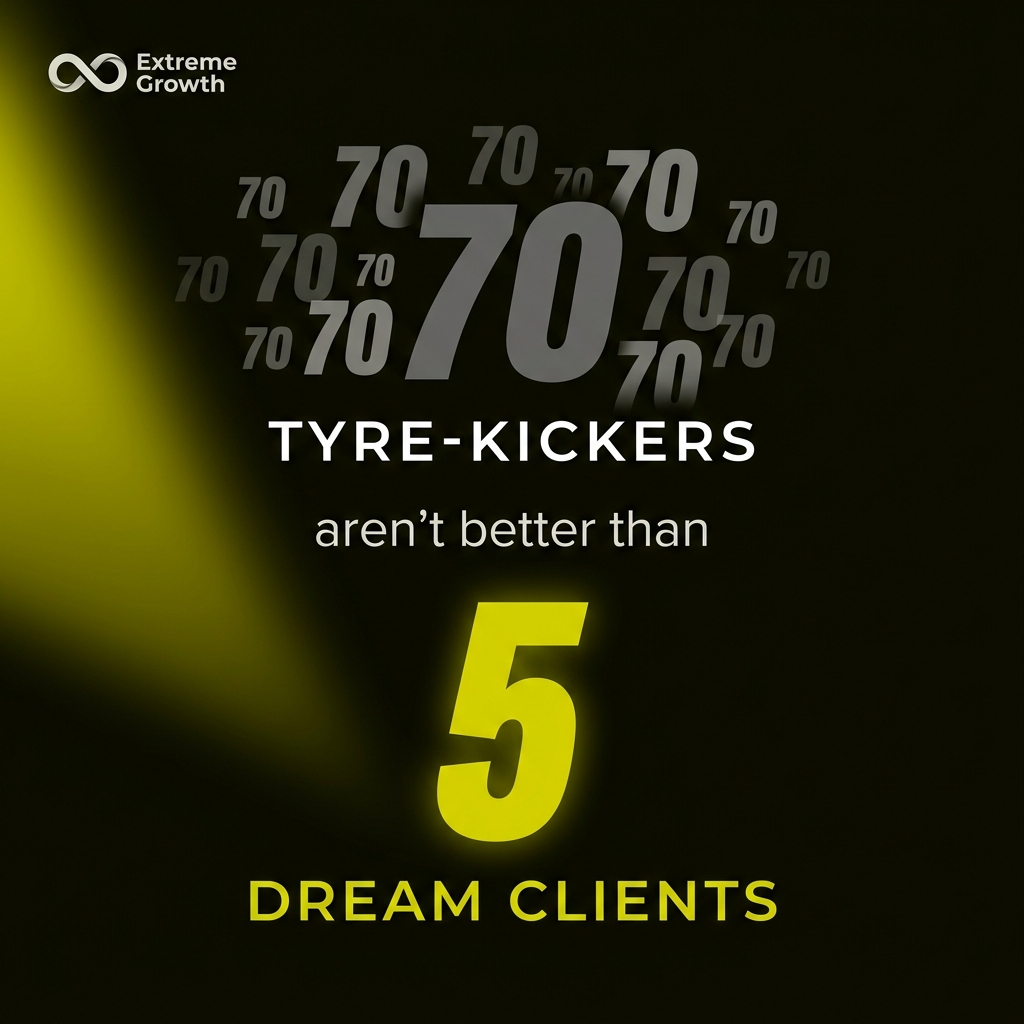
We believe: Seventy tyre-kickers aren't better than five dream clients.
I spent years chasing volume. Every inquiry felt like validation. Every consultation felt like progress. The calendar stayed full, the pipeline looked healthy, and the business stayed stuck.
Because volume optimises for the wrong metric.
When you're serving the affluent, conversion rate and client calibre matter infinitely more than lead count. One Adam (who closed £160,000 in three days on Zoom) is worth more than a hundred price shoppers who'll never move forward.
The shift happens when you stop measuring success by how many people want to talk to you and start measuring by how many of the right people recognise you as the only logical choice.
That requires positioning sharp enough to repel bad fits automatically.
On Scarcity and Constraint
The market believes: Artificial urgency drives decisions.
We believe: Real scarcity creates premium positioning.
Most scarcity is theatre. Limited-time offers. Countdown timers. Fake inventory warnings. The affluent see through it instantly because they've been marketed to their entire lives.
Real scarcity emerges from genuine constraint.
You can only serve a finite number of projects well. Your expertise has limits. Your capacity has boundaries. Your standards exclude most opportunities.
When you position that constraint as premium access rather than apologise for it, everything changes. Clients stop negotiating and start qualifying themselves. They ask how soon you can start, not whether you're worth the investment.
The objective is protection of positioning. Luxury retail depends on disciplined production planning, limited runs, and strategic pullbacks that signal confidence and reinforce exclusivity.
Your business works the same way.
On Referral Dependency
The market believes: Referrals are the best source of business.
We believe: Referral dependency is a ceiling masquerading as a strategy.
Some of my best projects came through referrals. Some of my best clients were lovely people introduced by builders and interior designers I'd worked with before.
But the control sat outside my business.
When you're dependent on someone else introducing you, you're under their wing. They steer the conversation. They set expectations. They position you as an attachment to their process rather than the expert advisor.
The interior designer quotes horsehair fabric everywhere because it looks beautiful. You know acoustically it's wrong for the space, but you can't override their decision without stealing their work. So you compromise. You deliver something good instead of something exceptional.
When clients come to you because of your positioning, you're the expert. You have creative licence. You get to explore your full potential to deliver the best possible outcome.
That's the difference between being a vendor and being an authority.
Research shows that 85% of ultra-wealthy clients prefer working with advisors referred by their inner circle. But here's what most people miss: that statistic describes their preference for trust, not their preference for discovery method.
When your positioning creates authority, you become the referral. You become the name that gets mentioned. You become the obvious choice before the conversation even starts.
On Founder Dependency
The market believes: Founder involvement ensures quality.
We believe: A business that requires your constant presence has no value.
I learned this the hard way. The tumour that nearly killed me grew for over a decade while I convinced myself the business needed me in every decision, every client conversation, every project detail.
If it can't scale without you, it's a high-paying job dressed up as a business.
The goal isn't to remove yourself from delivery. The goal is to remove yourself from being the bottleneck. Your positioning, your methodology, your voice needs to work whether you're in the room or not.
That's what creates an asset. That's what builds enterprise value. That's what lets you take three months off without the business collapsing.
Most boutique founders resist this because they've built their reputation on personal service. But personal service and founder dependency are different things. One creates loyalty. The other creates a trap.
On Specificity and Magnetism
The market believes: Broad positioning captures more opportunity.
We believe: Selling to everyone is selling to no one.
Generality creates obscurity. Specificity creates magnetism.
When you try to serve everyone, your message becomes wallpaper. It blends into the background noise of every other business claiming to be premium, bespoke, client-focused, results-driven.
The affluent don't respond to generic promises. They respond to precise articulation of the exact transformation they're seeking.
This doesn't mean narrowing your service offering. It means sharpening your positioning until the right people recognise themselves in your message and the wrong people self-select out.
Adam found me on Instagram. He sent a DM asking about a project. We hopped on a call the same day. He showed me his dated games room via video. I quoted subject to survey. He accepted the premium option. Then he upgraded after seeing content about interactive lighting.
No pitch deck. No proposal presentation. No negotiation.
Because the positioning did the work before we ever spoke.
On Category Creation
The market believes: Differentiation means being better than competitors.
We believe: Category of one positioning eliminates comparison.
Better is a trap. Better keeps you in the comparison game. Better means clients evaluate you against alternatives. Better means price becomes a factor.
Category of one means you're the only logical choice for a specific transformation.
A luxury brand without a story is just an expensive product. The same applies to your business. Your positioning isn't decoration. It's the message itself.
When you create your own category, you define the criteria for success. You set the standards. You establish the language. Clients either want what you offer or they don't. There's no middle ground because there's no comparison.
This requires clarity most businesses never achieve. It requires saying no to opportunities that don't fit. It requires confidence in your methodology even when the market doesn't understand it yet.
But it's the only positioning that scales without commoditising your offer.
On Price and Value
The market believes: Price is a barrier to overcome.
We believe: When positioning is precise, price becomes proof of value.
The right client doesn't negotiate. They recognise.
When someone questions your pricing, it's rarely about the number. It's about unclear value. It's about positioning that hasn't done its job. It's about a message that left room for doubt.
Premium clients understand that exceptional outcomes require exceptional investment. They've made those investments before. They know cheap is expensive when it fails to deliver.
What they need is certainty that you're the right choice. That your methodology works. That the transformation you're promising is achievable and worth pursuing.
Price resistance signals positioning weakness, not market reality.
Research confirms that high net worth clients don't hire generalists. They want experts who understand their specific challenges. Specialisation gives you the strongest competitive advantage.
When you're the specialist, price becomes a qualifier rather than an objection.
On Systems and Scalability
The market believes: Growth requires more people and bigger teams.
We believe: Scalability means increasing revenue without proportionally increasing costs.
Most businesses scale by adding bodies. More salespeople. More project managers. More overhead. Revenue grows, but profit margins stay flat or shrink.
Real scalability comes from systems that work without constant human intervention.
Your positioning becomes a system when it pre-qualifies clients before they contact you. Your methodology becomes a system when it delivers consistent outcomes regardless of who implements it. Your voice becomes a system when it attracts the right opportunities automatically.
This isn't about automation for automation's sake. It's about building infrastructure that scales trust without diluting value.
The goal is a business that grows more valuable as it grows larger, not one that becomes more complex and fragile.
On Authority and Expertise
The market believes: Credentials create authority.
We believe: Authority emerges from systematic demonstration of expertise.
Qualifications open doors. Experience builds confidence. But authority comes from consistently proving you understand the client's world better than they do.
This happens through content that educates rather than sells. Through frameworks that clarify rather than confuse. Through positioning that demonstrates mastery without needing to claim it.
The next decade of affluent marketing will be won by more authentic and authoritative messengers. Louder messaging won't win. Better messengers will.
Authority isn't something you declare. It's something the market grants you when your positioning, your content, and your results align consistently over time.
On Market Conditions and Control
The market believes: External conditions determine success.
We believe: Focus on what you can control. Ignore what you can't.
Politics, economic noise, market panic. All irrelevant.
Opportunity exists in every condition if you position correctly. Recessions don't stop the affluent from investing in outcomes they value. Market downturns don't prevent transformations that matter.
What changes is the clarity required. When uncertainty rises, positioning needs to be sharper. When budgets tighten, transformation needs to be more compelling. When competition increases, category creation becomes more valuable.
The businesses that thrive in difficult markets are the ones that stopped blaming conditions and started controlling their positioning.
What This Means for You
If you're reading this and recognising your own business in the problems we've described, you're already ahead of most people. Awareness precedes change.
The question is whether you're ready to do the work.
Positioning isn't a weekend project. It's not a messaging tweak or a website refresh. It's a fundamental rethinking of how you create value, communicate that value, and systematise delivery.
It requires honesty about what's working and what isn't. It requires letting go of opportunities that don't fit. It requires building systems that feel uncomfortable at first because they remove you from the centre of everything.
But the alternative is staying trapped in referral dependency, founder bottleneck, and revenue volatility. The alternative is building a business that owns you instead of one you own.
We've built the methodology because we lived the problem. The £340,000 client disaster. The stress-induced tumour. The realisation that working harder wasn't the answer.
What works is positioning that creates authority. Systems that scale trust. Messaging that attracts dream clients and repels bad fits automatically.
That's what we build. That's what we believe. That's the manifesto.
If it resonates, you know where to find us.


