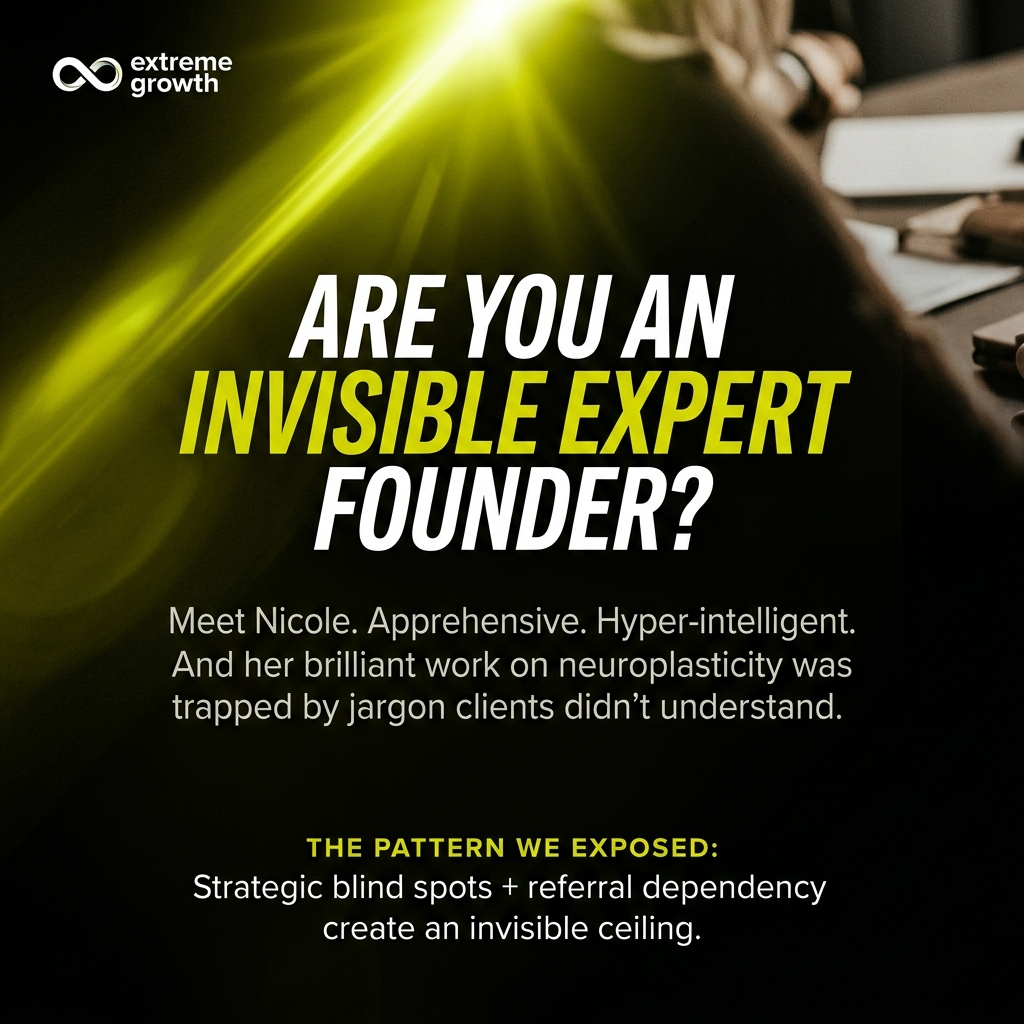
The Expert Who Couldn't Explain What She Did
Nicole came to the workshop apprehensive.
She'd built a practice around neuroplasticity and physical systems. Super intelligent. Deeply knowledgeable. The kind of expert who sees connections most people miss.
But when I looked at her website, her LinkedIn profile, her content - I couldn't tell you what she actually did.
And if I couldn't figure it out, her ideal clients definitely couldn't.
The Chessboard Problem
I see this pattern constantly with expert founders.
They understand the whole chessboard. Every move. Every position. Every strategic possibility three steps ahead.
Their clients? They're just trying to figure out the next move.
The gap between those two perspectives creates a communication breakdown that costs expert founders everything. Not because they're bad at what they do. Because they're too good at it.
Nicole operated from a really advanced level. She spoke about her core truth system, about the physical and the neuroplastic, about rewiring patterns most people don't even know exist.
Normal people looked at her content and felt overwhelmed.
They couldn't see the difference between what she offered and what everyone else offered. So they treated her like a commodity. Price became the only differentiator because the value wasn't translating.
What the Audit Exposed
Our Expert Authority Audit runs over four days. First we focuses on category-of-one positioning. Our Ai Prompt runs a complex interview process designed to extract the insights and data required it won't let you off the hook.
Most people's experience with ChatGPT or Claude involves typing a prompt and getting generic output. They assume AI just fills gaps with internet references and moves on.
Our prompts work differently.
They control the extraction of information through a structured interview process. When you give a poor answer, the AI doesn't guess or fabricate. It comes back and digs deeper. It's the same process we use in our £4,000 paid engagements, distilled into a format expert founders can run themselves.
For Nicole, the process highlighted something she couldn't see on her own.
She had the expertise. She had the results. She had transformational capability.
What she didn't have was a way to communicate it that landed with the people who needed it most.
Most brands have high-quality content and strong products, yet lose visibility due to structural, semantic, or technical gaps. The gap between what founders know they offer and how the market perceives them caps growth without being immediately obvious.
Nicole's gap wasn't about capability. It was about translation.
The Shift
After the workshop, Nicole renamed herself.
Not her business. Herself.
She became a human systems architect.
Her messaging shifted from neuroplasticity jargon to something her ideal clients could actually recognise: "I work where burnout, disconnection, the quiet collapse beneath high achievement actually begin."
She now speaks about rewiring the body and the mind for clarity, resilience, and authentic success.
Same expertise. Same capability. Completely different market position.
The transformation wasn't about dumbing down her knowledge. It was about meeting her clients where they live, not where she operates.
Why Expert Founders Stay Invisible
Nicole's story isn't unique.
Strategic blind spots represent misalignments between your content strategy and audience intent, search behaviour patterns, and market positioning opportunities. These blind spots are more dangerous than surface-level gaps because they represent fundamental disconnects between what you're saying and what your ideal clients are seeking.
Expert founders suffer from a specific type of invisibility.
They possess deep expertise. They deliver transformational results. But they compete on price because their value doesn't translate into language their market understands.
The pattern plays out the same way every time:
They get busier. More work. More posts. More time spent. More networking. More coffee meetings.
But the further they enhance their skills and become the expert, the harder it becomes for them to communicate with clients.
They're trapped in referral dependency. Sixty-five per cent of new business opportunities come from referrals and recommendations. Word of mouth affects 20 to 50 per cent of purchasing decisions. Powerful, but it creates an invisible ceiling. You can't scale what you can't systematise.
Referral dependency functions as both lifeline and constraint. It keeps you busy enough to survive but not visible enough to scale.
What Actually Changed
The workshop didn't teach Nicole new skills.
It exposed the gap she couldn't see herself. The distance between her expertise and her market's comprehension.
Day one extracted her category-of-one positioning. Day two clarified her ideal client. Day three built her authority story. Day four delivered the complete blueprint with quick wins, a 90-day stretch, and a 12-month view.
By the end, Nicole had something she'd never had before: a positioning system that did the heavy lifting for her.
Her message now attracts the right people and repels bad fits automatically. She's not chasing leads. She's not explaining herself repeatedly. She's not negotiating on price.
The clarity created magnetism.
The Real Cost of Invisibility
Businesses approaching £1 to £5 million in turnover often hit a plateau. The constraint isn't market demand. It's the founder becoming the bottleneck for decision-making, delegation, and development. The business can only grow as much as the founder can personally manage.
When your expertise doesn't translate into clear positioning, you become the only person who can sell your service. Every conversation requires you. Every client needs your personal explanation. Every sale depends on your ability to articulate value in real time.
That's not a business. That's a high-paying job with no exit value.
Nicole's transformation wasn't just about better messaging. It was about building an asset that works without her constant presence.
Her positioning now does what she used to do manually in every sales conversation. It pre-frames. It qualifies. It positions her as the singular choice for a specific transformation.
What This Means for You
If you're an expert founder, you probably recognise parts of Nicole's story.
You know you're good at what you do. You deliver results. You have depth of knowledge most people in your field don't possess.
But you're still explaining yourself. Still justifying your fees. Still competing with people who don't understand what you actually do.
The problem isn't your expertise.
It's the gap between what you know and what your market can comprehend.
Category clarity prevents commoditisation. It shortens sales cycles. It attracts the right prospects and eliminates price negotiation.
But you can't see your own blind spots. You're too close to your expertise to recognise where the translation breaks down.
That's what the audit exposes.
The Expert Authority Audit Workshop runs over four days. We limit it to one founder per niche per geography. If someone's already registered as a human systems architect in your location, we won't take another.
Real scarcity. Not manufactured urgency.
The workshop delivers the same positioning system we charge £4,000 to build in our paid engagements. AI prompts that interview you like we would. A blueprint that covers positioning, ideal client, authority story, and implementation roadmap.
Nicole came in apprehensive about AI and unclear about her positioning.
She left with a message so sharp it does the selling for her.
If you're an expert founder trapped in referral dependency, stuck negotiating on price, or working harder without scaling, the gap isn't your capability.
It's your visibility.
And visibility starts with positioning that translates expertise into language your market actually understands.
So if your looking to generate 2-3 new business enquiries a week on autopilot either reach out about the next workshop, or speak to us about working 1:1 if your main constraint is time.
Either way we’ll transform your narrative and create a systematic approach to new business client acquisition.


