The Language Trap: Why Founder-Led Businesses Repel Premium Clients Without Knowing It
I spent twenty-five years in luxury home services before I realised the truth.
The language I used to describe what I did was actively repelling the clients I wanted most.
I called myself a "smart home integrator." Industry terminology. Accurate. Meaningless to anyone outside the sector. When prospects asked what I did, I'd launch into technical specifications, product features, installation processes. I thought I was demonstrating expertise.
I was demonstrating I didn't understand them.
Here's what I've learned building positioning systems for boutique luxury businesses: the words you use to describe yourself determine who shows up, what they expect, and whether they're willing to pay premium fees.
Most founders trap themselves with language borrowed from their industry. They accept category labels created by someone else, decades ago, designed for a market that no longer exists. Then they wonder why every conversation turns into a price negotiation.
The Category Label Problem
When you accept an existing category label, you accept everything that comes with it.
The pricing expectations. The competitive comparisons. The commoditisation. The assumption that what you do is fundamentally the same as what everyone else in that category does.
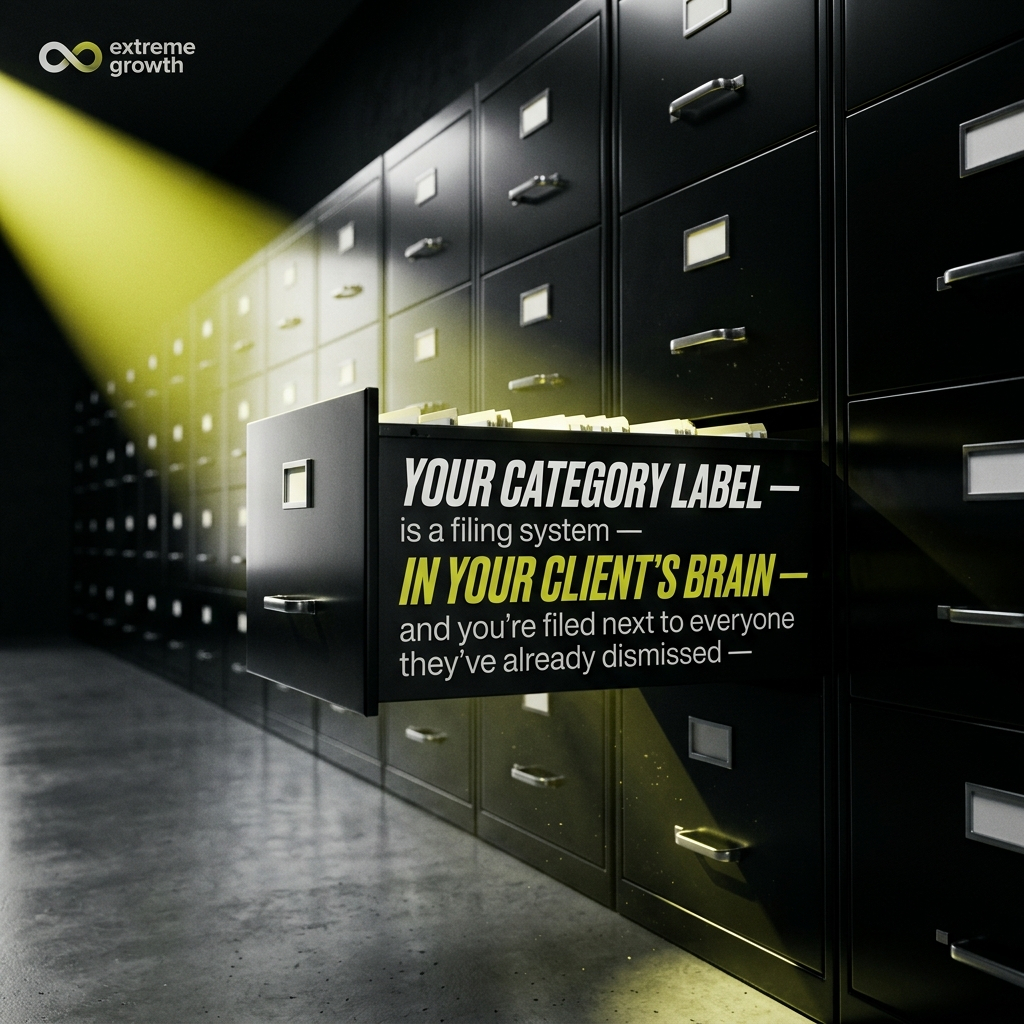
A category label isn't neutral. It's a filing system in your prospect's brain. When you say "I'm a wealth advisor," their brain immediately files you next to every other wealth advisor they've encountered. When you say "I'm an interior designer," you're competing with thousands of others who use the same label.
The research is clear: category creators experience much faster growth and receive much higher valuations than companies bringing incremental innovations to market. They don't compete in any traditional sense because they've created a perception that they're difficult to replace.
Tesla achieved this. They didn't position as a better car manufacturer. They formed a subcategory where all traditional competitors became irrelevant.
But here's what most people miss: you don't need to invent a new product to create a category. You need to reject the language that commoditises you.
How Founder Language Repels Premium Clients
Premium clients make decisions differently.
They're not shopping. They're not comparing. They're assessing whether you understand the transformation they're trying to achieve and whether you're the singular choice to deliver it.
When your language sounds like everyone else's, you've already lost. Because high-net-worth individuals seek exclusivity, exceptional quality, and experiences that reflect their status. They expect every touchpoint to convey sophistication and personalised attention.
Generic service descriptions don't do that.
I see this pattern constantly. A boutique architecture firm describes themselves as "providing bespoke residential design services." An estate management company says they "deliver comprehensive property solutions." A wealth advisor offers "holistic financial planning."
All true. All forgettable. All interchangeable.
The language is borrowed from industry conventions. It signals competence but not distinction. It describes process, not outcome. It speaks to what you do, not what changes for the client.
And here's the critical part: affluent clients don't respond to marketing—they respond to clarity of outcome.
When I was closing six-figure cinema installations, the clients who paid premium fees never asked about projector specifications first. They asked about the experience. What would change in their home? How would their family use the space? What would this mean for entertaining guests?
The clients who led with technical questions and price comparisons? They were the ones who'd already decided we were interchangeable with three other companies.
The Shift From Labels to Categories of One
Creating a category of one means rejecting industry terminology and building language around the specific transformation you deliver.
This isn't branding. This isn't clever copywriting. This is strategic positioning that makes you incomparable.
When I repositioned from "smart home integrator" to someone who architects premium client acquisition systems for boutique luxury businesses, everything changed. The language itself filtered prospects. People who wanted a "marketing consultant" or "business coach" didn't reach out. People who recognised they needed a systematic approach to attracting high-calibre clients without referral dependency did.
The positioning became the qualification mechanism.
I learned this principle from studying how category creators operate. They don't just differentiate within an existing market. They redefine what market they're in by controlling the language used to describe the problem and solution.
Before snowboards, there were snurfers. Failed category labels are laughable in hindsight. But at the time, accepting that terminology would have limited the entire sport's growth.
Your industry terminology is doing the same thing to your business.
What Authority Architect Positioning Actually Means
I didn't arrive at "Authority Architect" by accident.
I tried consultant. Too vague. Everyone's a consultant. It signals advice-giving, not implementation. Clients expect documents and recommendations they'll struggle to execute.
I tried strategist. Better, but still passive. Strategists create plans. They don't build the infrastructure that makes those plans work.
I tried agency. Wrong entirely. Agencies run on retainers and volume. They optimise for activity, not outcomes. They're hired to execute someone else's vision.
None of these labels captured what I actually do: architect the positioning, messaging, and acquisition systems that establish boutique founders as the singular authority in their market.
Authority Architect works because it's specific enough to be meaningful and unfamiliar enough to require explanation. When someone asks what that means, I'm not competing with their existing mental category. I'm creating a new one.
The explanation becomes the positioning.
This is what category leadership looks like in practice. You're not claiming to be better than competitors. You're demonstrating that traditional comparisons don't apply because you're solving a different problem in a different way.
The Mechanics of Category Creation
Creating your own category isn't mystical. It's methodical.
First, you identify the transformation your ideal clients are trying to achieve. Not the service you deliver. The outcome they're buying.
A luxury interior designer isn't selling room layouts. They're selling the experience of walking into a space that reflects status, taste, and identity. An estate manager isn't selling property maintenance. They're selling the freedom to travel without worry and the confidence that their most valuable asset is protected.
Second, you examine the language your industry uses and recognise where it fails to capture that transformation.
Industry language is built for insiders. It's technical, process-focused, feature-heavy. It assumes the prospect already understands the value and is simply comparing providers.
Premium clients don't think that way. They're not comparison shopping. They're looking for someone who understands their world and can deliver an outcome they can't achieve themselves.
Third, you build new language that describes the transformation in terms that resonate with how your ideal clients think about their goals.
This is where most people fail. They create clever taglines or marketing slogans. That's not what I'm describing. I'm talking about a complete repositioning of how you describe the problem you solve, the clients you serve, and the outcomes you deliver.
When luxury brands fail, it's usually because they possess resources but fail to understand what true luxury positioning requires. A luxury brand without a story is just an expensive product. A luxury brand with a strong narrative creates a complete brand experience.
Your category language is that narrative.
Why This Matters More in Discretionary Markets
In commodity markets, category labels work fine. People know what they want. They're comparing price and convenience. The label helps them find options quickly.
In discretionary luxury markets, category labels destroy value.
Because luxury consumers in 2025 expect to feel recognised, not targeted. This distinction matters enormously when building brands that command premium prices and long-term loyalty.
When you accept a category label, you're telling premium clients you're comparable. You're inviting them to shop around. You're suggesting that price is a reasonable basis for decision-making.
That's the opposite of what creates premium positioning.
I learned this the hard way. Early in my career, I'd close projects at £340,000 and still end up in disputes over a £3,000 projector. Why? Because my positioning invited negotiation. I'd positioned as a provider of products and services, not as the architect of a specific transformation.
The language I used created the problem.
When I shifted to positioning around outcomes—creating cinema experiences that became the centrepiece of family life and entertainment—the conversations changed. Clients stopped asking about individual component costs. They started asking about the overall experience and whether I could deliver it.
One client, Carl, initially wanted to replicate his Texas cinema in his London home. He had specific equipment in mind. I questioned every choice. Not to upsell. To ensure he'd achieve the experience he actually wanted.
He valued that. Because I wasn't taking orders. I was architecting an outcome.
That's what premium clients pay for. And it only works when your positioning makes it clear that's what you do.
The Practical Reality of Rejecting Industry Labels
When you reject industry terminology, you create friction.
People don't immediately understand what you do. You can't rely on existing mental categories. Every conversation requires more explanation.
This feels inefficient. It feels like you're making things harder than they need to be.
You are. Deliberately.
Because that friction is a filter. The people who aren't willing to understand what makes you different aren't your ideal clients anyway. They're looking for the cheapest version of a commodity service.
The people who lean in, who ask questions, who want to understand the distinction? Those are the clients who'll pay premium fees and refer others like them.
I saw this when I launched my repositioned offer. Enquiries dropped initially. But quality skyrocketed. Instead of fielding twenty calls from people shopping for the lowest price, I had five conversations with people who'd already decided I was the right choice. They just needed to confirm fit.
The research backs this up. Vague positioning creates vague work. Positioning must be sharp enough that it closes options as well as opens them.
That's uncomfortable for most founders. They want to keep options open. They don't want to exclude anyone who might become a client.
But in premium markets, trying to appeal to everyone means you appeal to no one who matters.
What Happens When You Get This Right
When your positioning creates a category of one, several things happen.
First, price conversations disappear. Not because you're expensive. Because you're incomparable. There's no reference point for negotiation.
Second, referrals improve. People can explain what makes you different because you've given them language that captures it. They're not saying "use this architect, they're really good." They're saying "this person solves exactly the problem you're describing in a way nobody else does."
Third, your marketing becomes easier. You're not fighting for attention in a crowded category. You're educating people about a transformation they didn't know was possible.
Fourth, you attract clients who are pre-sold. They've already decided you're the right choice. The sales conversation becomes about fit and logistics, not convincing them of value.
I've seen this play out repeatedly. Adam reached out via Instagram. Within three days, he'd closed a £160,000 project on Zoom without a site visit. No pitch deck. No proposal comparison. He recognised the transformation I described and wanted it.
That's what category of one positioning creates.
The alternative is what I experienced with the £340,000 litigation client. He saw me as interchangeable with any other installer. When problems arose, there was no relationship equity. No recognition of unique value. Just a transactional dispute over who owed what.
Your positioning determines which type of client you attract.
The Path Forward
If you're a founder using industry terminology to describe what you do, you're leaving money on the table.
More importantly, you're attracting clients who'll never value what makes you different.
The shift starts with recognising that category labels are choices, not facts. Someone created that terminology. You can create different terminology that better captures the transformation you deliver.
This requires work. You need to understand your ideal clients deeply enough to know what outcomes they're actually buying. You need to examine your industry's language critically enough to see where it fails. You need to build new language that's specific, meaningful, and ownable.
But the payoff is substantial. Category creators experience much faster growth and receive much higher valuations because they've radically differentiated themselves by creating a perception that they're very difficult to replace.
You don't compete in any traditional sense when you've created your own category.
That's the difference between being a consultant who hands over documents and an Authority Architect who builds the complete infrastructure for premium client acquisition.
One is a label. The other is a category of one.
The language you choose determines which one you become.


