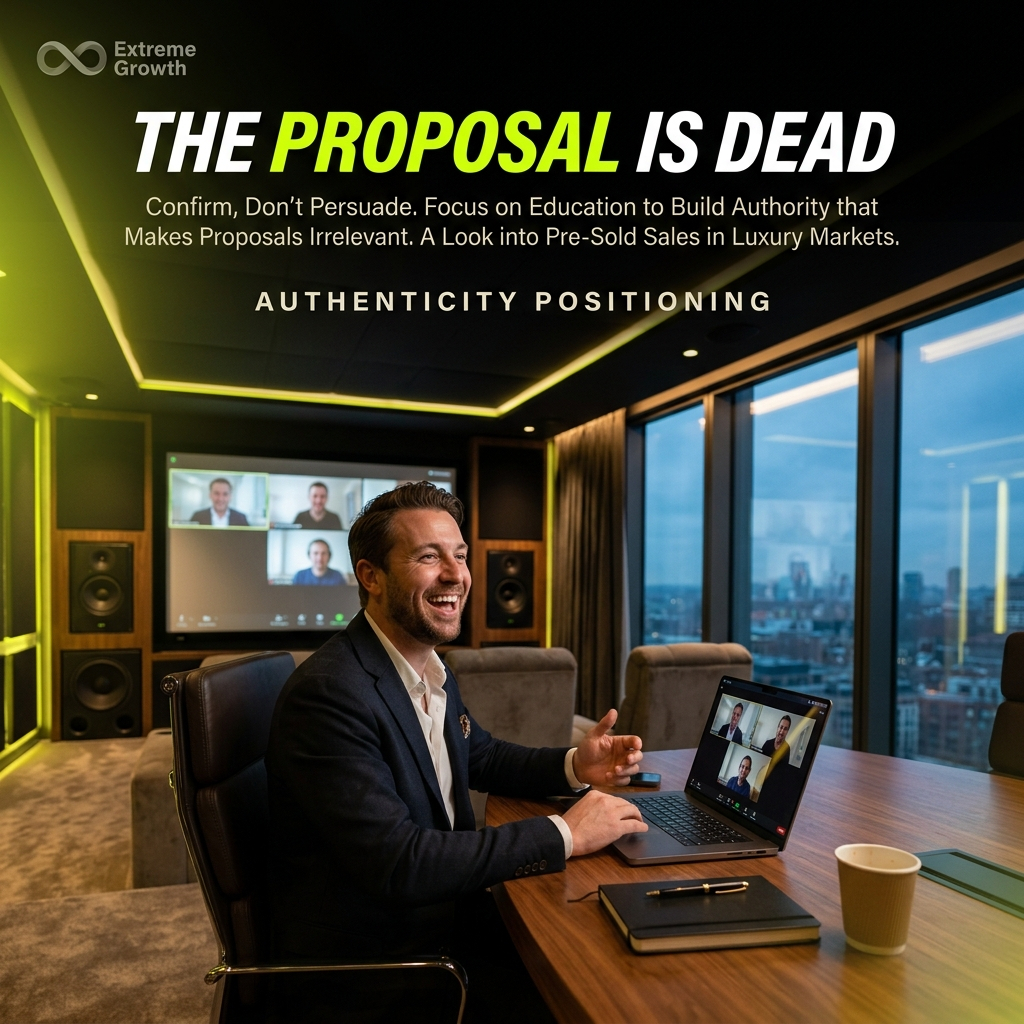
The Three-Day Close: What Actually Happens When You Stop Selling
Adam spent £160,000 in three days on Zoom calls.
No site visit. No proposal. No negotiation.
He messaged me on Instagram asking about a cinema room project. We talked the same day. Three days later, he'd placed the order. A few weeks after that, he called back and added another £30,000 for interactive lighting he'd seen in one of my posts.
The entire thing happened without a single traditional sales tactic.
I've been thinking about what actually changed between the version of me who would have chased that project with proposals and presentations, and the version who closed it in three video calls whilst the client drove the urgency.
Because the mechanics matter. This wasn't luck. It was the predictable outcome of positioning work that most people refuse to do because it feels too slow, too indirect, too far removed from "getting leads."
The Proposal Process Is Already Dead
You're still writing them because everyone else is. But doubt is expensive in luxury markets. When buyers sense uncertainty about what they're getting, they lower offers, tighten terms, or move on to something that feels less complicated.
The proposal itself signals doubt.
It says: "I'm not sure you want this, so here's a document that tries to convince you." It positions you as someone who needs to persuade rather than someone whose expertise is already recognised.
Adam didn't need persuading. He needed to understand possibilities.
When we first spoke, he started describing what he wanted based on a cinema he already had in Texas. He thought he knew what good looked like because his room was better than his friends' rooms. But I questioned his equipment choices. The subwoofers were undersized for the London room. The speakers wouldn't deliver the experience I'd recommend at that budget level. The projection setup was limiting what was possible.
He didn't get defensive. He got curious.
That's what happens when someone recognises expertise rather than resists a sales pitch. High-net-worth individuals value certainty of process, not certainty of outcome. They understand uncertainty exists, but they want structured decision-making and transparent options that eliminate surprises.
I wasn't there to take his order. I was there to make sure he didn't build something he'd regret.
What Changed in My Approach
For years, I ran a custom cinema installation business. Revenue hit seven figures. Projects were impressive. Clients were wealthy.
And I was completely trapped.
Every project came through referrals. Builders who knew working with us made their lives easier. Interior designers who'd seen our work. Architects who trusted our technical capability. The referrals were good, but the control was outside our business.
When you're dependent on someone else introducing you, you're under their wing. The interior designer has already spec'd horsehair fabric everywhere because it looks beautiful, and you know acoustically it's wrong for the room. But you can't steal their work because they brought you in. The builder has told the client a timeline that doesn't account for the realities of custom integration, and you're stuck managing expectations you didn't set.
You're an attachment to someone else's process.
The shift happened when I stopped trying to get better at proposals and started building authority that made proposals irrelevant. Not authority as in "thought leader with a big following." Authority as in: when someone in this market has this problem, my name comes up, and they already understand what I do differently.
That positioning work created three specific changes:
First, the client arrived pre-educated. Adam had already seen my content. He understood my approach to cinema design. He knew I prioritised experience over equipment lists. When we talked, we weren't starting from zero. We were starting from "I've seen your work, I understand your philosophy, now help me apply it to my situation."
Second, I became the expert advisor, not the vendor. When Adam showed me his room on video and described what he wanted, I had the freedom to challenge his assumptions. Not because I was trying to upsell him. Because I genuinely knew he was limiting what was possible, and my job was to show him what he couldn't see on his own.
Third, he controlled the timeline, not me. I offered a survey date three weeks out. He said he'd rather not wait and asked if I could quote subject to survey based on a video walkthrough. That's client-led urgency. He was moving faster than I was because he'd already decided he wanted to work with me. The only question was logistics.
The Mechanics of Pre-Sold Conversations
People think "pre-sold" means the client shows up ready to sign. That's not quite right.
Pre-sold means they've already answered the question "Should I work with this person?" in their head before the first conversation. The sales process isn't about convincing them you're credible. It's about confirming they're right about you and figuring out if you're the right fit for each other.
That's a completely different conversation.
When I was chasing referrals, every conversation started with proving ourselves. Showing credentials. Explaining our process. Justifying our pricing. Building trust from scratch because the client didn't really know us, they just knew someone who knew us.
When Adam called, trust was already established. He'd consumed enough of my content to understand how I think about cinema design. He'd seen projects I'd completed. He understood the transformation I deliver isn't just "a room with a big screen," it's a space his family will actually use and love for years.
The conversation became consultative immediately.
I asked about his family. His son was five. His wife had specific ideas about aesthetics. He loved film and wanted something that would make him excited to watch movies at home instead of going out. Those details shaped everything. The seating layout. The acoustic treatment. The lighting design. The control system complexity.
We weren't negotiating. We were co-creating.
And when I sent the proposal, it wasn't a persuasion document. It was a confirmation of what we'd already agreed, with options for different finish levels and a premium path that included the interactive lighting system.
He chose the premium option. Then upgraded again a few weeks later.
Why This Doesn't Scale Through Proposals
The traditional sales process optimises for volume. Cast a wide net. Generate lots of leads. Qualify them. Present proposals. Follow up. Close a percentage.
That works when you're selling something commoditised where the main differentiator is price or convenience.
It fails completely in premium markets.
Luxury property buyers are not driven by impulse purchases. They observe, compare, and select. They only visit properties that truly meet their criteria, which means a poorly positioned property simply won't be visited.
The same applies to premium services.
If your positioning is unclear, you don't get the conversation. If your positioning is clear but you're positioned as a vendor rather than an expert, you get the conversation but you're competing on price. If your positioning establishes expertise and authority, you get conversations with people who've already decided they want to work with you.
The proposal process assumes you need to convince someone. Authority positioning assumes they're already convinced and you're helping them make the right decision.
Those are fundamentally different starting points.
What Actually Builds This Kind of Authority
I spent three decades learning to sell. Door-to-door at sixteen. Technology sales in my twenties. Six-figure cinema projects in my thirties. I closed deals on phone calls. I learned to read people. I developed instincts for what moves a conversation forward.
All of that mattered.
But what changed everything was systematising that knowledge into positioning that works without me being in the room.
When someone finds my content, they're not just learning about cinema design. They're learning how I think. What I value. What I refuse to compromise on. The questions I ask that other people don't. The problems I solve that they didn't know they had.
That's not marketing. That's education.
And education builds trust faster than any sales conversation ever could, because the person is choosing to pay attention rather than being interrupted by your outreach.
The mechanics are simple but not easy:
You have to know what you actually believe. Not what sounds good in a proposal. What you genuinely think is true about your market, your clients, and the transformation you deliver. If you can't articulate that clearly, your positioning will be generic.
You have to be willing to repel bad fits. When I talk about cinema design, I'm explicit about what I won't do. I won't build a room that prioritises aesthetics over acoustics. I won't install equipment that's impressive on paper but wrong for how the client will actually use the space. I won't take projects where the client just wants the cheapest option. That clarity repels people who aren't right for me, which is the entire point.
You have to build in public consistently. One post doesn't create authority. One article doesn't establish expertise. It's the accumulated body of work over time that shifts perception from "someone who does this" to "the person who thinks deepest about this."
You have to trust the process when it feels slow. Authority positioning doesn't produce leads on day one. It produces better leads over time. Leads that close faster. Leads that don't negotiate. Leads that refer other ideal clients because they're genuinely excited about the transformation you delivered.
The Death of the Proposal Process
I still send proposals. But they're not persuasion documents anymore.
They're confirmation documents. Summaries of what we've already agreed. Options for different approaches. Transparent pricing that reflects the value we've already established in conversation.
The sale happens before the proposal gets sent.
When Adam and I finished our first call, he already knew he wanted to work with me. The proposal just formalised the details. When Carl spent £350,000 on a cinema in London, the proposal was a formality. The real work happened in the conversations where I challenged his assumptions and showed him possibilities he hadn't considered.
That's what authority positioning enables.
You stop convincing and start confirming. You stop chasing and start attracting. You stop competing on price and start being recognised for expertise.
The proposal process isn't dead because proposals don't work. It's dead because the entire paradigm of "present options and hope they choose you" is backwards in premium markets.
A well-executed off-market sale, where the right buyer is found and allowed to make a confident decision, can result in above-market outcomes. The same principle applies to premium services. When you position correctly, you're not competing in an open market. You're the obvious choice for a specific transformation.
Adam didn't compare me to three other cinema companies. He found me, recognised I understood what he wanted better than he did, and moved forward. The three-day close wasn't fast because I'm a great salesperson. It was fast because the positioning work had already done the heavy lifting.
That's the shift most people miss.
They're optimising the wrong part of the process. They're trying to get better at proposals when they should be making proposals irrelevant. They're trying to close faster when they should be attracting people who are already ready to close.
The mechanics of premium sales haven't changed. Trust still matters. Expertise still matters. Understanding the client's actual needs still matters.
What's changed is where that work happens.
It doesn't happen in the proposal. It happens in the positioning that brings the right people to you, already convinced you're the person who can help them, already moving at their own pace toward a decision they've essentially already made.
The proposal just makes it official.


